Ferrari Paint Protection Film in Manchester
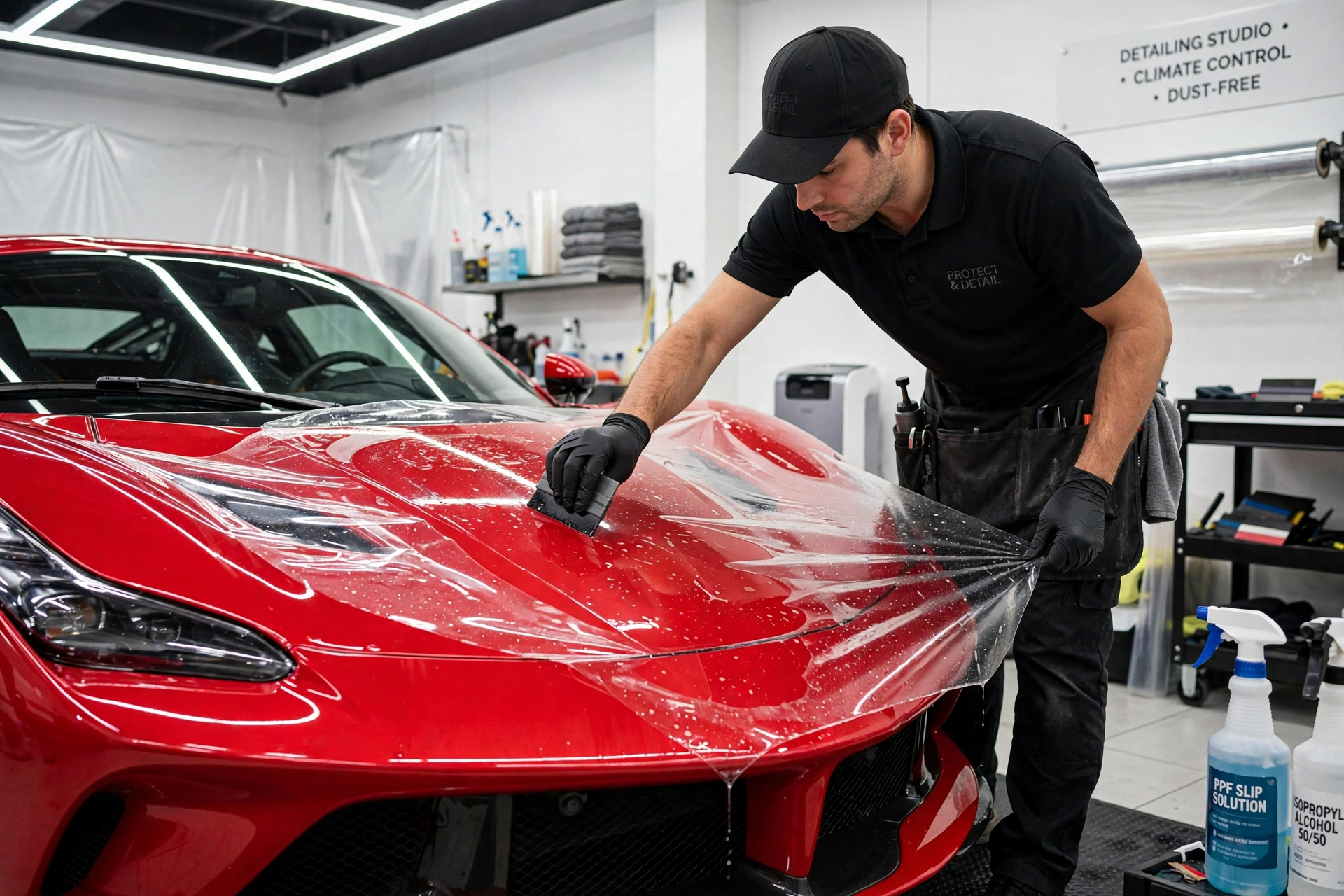
Paint protection film (PPF) is a clear polyurethane film applied to a Ferrari’s paintwork as a physical barrier against stone chips, scratches and road rash. A ceramic coating adds gloss, chemical resistance and hydrophobics but cannot stop chips; PPF can. The two solve different problems and are combined — film on high-impact zones, ceramic coating over the whole car.
Key facts
- What PPF is
- A transparent polyurethane film, around 150–200 microns thick, that absorbs stone chips and scratches.
- PPF vs ceramic
- PPF is physical chip defence; ceramic coating is chemical resistance, gloss and hydrophobics — different jobs.
- Best combination
- Film on the high-impact zones with ceramic coating over the whole car, including over the film itself.
- Self-healing
- Modern films are self-healing — light swirls disappear with warmth — and optically clear.
If stone chips keep you awake at night, paint protection film is the only answer that actually works. PPF is a transparent, self-healing polyurethane film — applied to the panels that take the punishment — that absorbs impacts a ceramic coating can only watch happen. On a Ferrari, where a resprayed front bumper can cost thousands and original paint protects value, that physical barrier matters.
This page is the honest guide: what automotive paint protection film is, where it earns its keep on a Ferrari, how it differs from a ceramic coating, and what separates a quality installation from a poor one. Whether you want full-body coverage or just the high-impact zones protected, request a free quote and we will talk through the options for your car and how you drive it.
What Paint Protection Film Actually Is
Car paint protection film is a transparent thermoplastic polyurethane film, typically around 150–200 microns thick, computer-cut or hand-cut to your Ferrari’s panels and applied with a slip solution. Modern films are self-healing — light swirls disappear with warmth — and optically clear, so the paint colour shows through unchanged. That is ppf paint protection in its proper form: invisible, warrantied and cut for the car, not a generic sticker.
It is not a styling wrap: a clear car wrap or clear vehicle wrap changes nothing about the colour — it is invisible armour. Nor is it a coating. You will see the term ppf coating online, but film and ceramic are different products doing different jobs — which is exactly why many owners have a ceramic coating applied over their PPF, combining chip defence with gloss and hydrophobics.
Search for ppf film or ppf film for car and you will find two supply routes: pre-cut car paint protection film kits for DIYers, and bulk ppf roll or paint protection film roll sold by the metre. Ferrari panels — compound curves, deep intakes, tight shut-lines — are among the hardest in the industry to fit well, and a poor DIY installation is very visible on dark paint.
PPF vs Ceramic Coating: An Honest Comparison
They solve different problems. PPF is a physical barrier — it absorbs stone chips, scratches, scuffs and road rash that would otherwise reach your paint. A ceramic coating is chemical protection — it adds gloss, UV and chemical resistance, and hydrophobic water behaviour, and makes washing easier. PPF cannot make water bead like a coating; a coating cannot stop a stone chip. Neither replaces the other.
The sensible Ferrari answer is usually both: ppf car protection on the high-impact zones — front bumper, bonnet leading edge, wings, mirrors, sills and rear arches — with a ceramic coating over the entire car, including over the film. The film takes the hits; the coating keeps everything glossy, easier to wash and chemically resistant. Ask about the combination when you request a free quote.
Where PPF Earns Its Keep on a Ferrari
Not every panel needs film. On a Ferrari, the punishment concentrates in predictable places: the front bumper and bonnet leading edge take the brunt of motorway stone chips, the mirrors and front wings catch spray and debris, and the sills and rear arches collect grit thrown up by wide rear tyres. A bonnet protection film section plus bumper and mirror coverage — often called a ‘front-end’ package — protects the zones responsible for the vast majority of chip damage.
Full-body ppf wrap coverage exists for concours cars and high-mileage daily drivers, and it is the ultimate protection — but it is also a serious investment, typically several times the cost of a ceramic coating detail. For most owners, targeted automobile ppf on the impact zones plus a quality ceramic coating elsewhere is the sweet spot of protection, appearance and value.
Protective Film for Cars: Brands and Installers
You will see brand names everywhere in PPF discussions — XPEL PPF and XPEL paint protection film are among the most searched, alongside a handful of other professional films. These are product brands, not installers: the film matters, but the installation matters more. A top-tier film fitted badly will look worse and protect less than a mid-tier film fitted by a craftsman with sharp blades, clean edges and properly wrapped panel edges.
Ask any installer which film they use and why, how they handle edges (wrapped edges resist lifting and dirt lines far better than cut-on-panel edges), and whether paint correction is included before fitting — film locks in whatever is underneath, just like a coating does. Clear protective film should be exactly that: clear, with no orange-peel distortion, no trapped dust and no visible seams from a normal viewing distance.
Searches for automotive ppf, auto paint protection film, ppf car wrap or clear paint protection film all describe the same product category — what varies between films is thickness, optical clarity, the self-healing top coat and the warranty behind it. UK buyers should compare installed examples in person: spec sheets never tell the full story.
Our Ferrari PPF installation process
Five stages from first inspection to cured handover. Film is only as good as its installation — this is where a specialist earns the fee.
- 1
Consultation and panel assessment
We agree which panels get film — full front end, high-impact zones or full body — and inspect the paintwork under specialist lighting. Any damage the film would lock in is identified now.
- 2
Decontamination and paint correction
The panels are decontaminated and machine-polished first, because film magnifies nothing but also hides nothing — swirls and bonded contamination trapped under PPF stay visible for years.
- 3
Precision cutting
Film is computer-cut from patterns matched to your exact Ferrari model and year, with edges planned to wrap where possible. Wrapped edges resist lifting and dirt lines far better than edges cut on the panel.
- 4
Application and alignment
Each piece is applied with slip solution, positioned precisely and squeegeed out from the centre, working the film into curves and recesses without stretching it thin. This is the step where experience shows — rushed fitting leaves fingers, bubbles and silvering.
- 5
Curing, inspection and handover
Edges are sealed and the car rests while the adhesive cures. We inspect every panel under specialist lighting for dust, lift or distortion, then hand over with aftercare guidance — including when the car can be washed and how the self-healing top coat works.
Related Ferrari protection guides
Serving Manchester & Greater Manchester
Ferrari life in Manchester means motorway miles: the M60, M56 and M62 throw up the grit and stone chips that PPF is made for, and winter gritting salt attacks unprotected front ends. For paint protection film in the UK, local fitting matters — film cut for your exact model, installed by someone who knows Ferrari panel gaps, from Didsbury to Wilmslow and across Greater Manchester.
Areas we serve
ManchesterSalfordStockportAltrinchamTraffordBuryOldhamWigan
Ferrari ceramic coating across Manchester & Greater Manchester — Manchester service area →
Frequently asked questions
Is PPF better than ceramic coating for a Ferrari?
Will PPF change how my Ferrari looks?
How long does paint protection film last?
Is XPEL PPF worth it, or are other films just as good?
Can you put ceramic coating over PPF?
Can I fit PPF to my Ferrari myself with a pre-cut kit?
Get your free, no-obligation quote
Tell us which Ferrari you drive and what it needs. We'll reply with an exact price and the earliest available slot.